Thread Update Sept 19, 2016: We have done a number of upgrades to our tester Joe's 2013 1LE Camaro this year. After testing a revised version on it, we made a production run of 5th gen Camaro camber plates. Since then many have been been sold to racers. Over the summer I raced this Camaro in two autocross events in the CAM class, then this past weekend I was able to get my first track laps in the car. I also made laps in a 2017 C7 Corvette Grand Sport and a 2012 C6 Corvette Z06 that same day. Compared to these two "sports cars" this 3800 pound Camaro gave some very surprising results! Video and data is below.
As I mentioned in my last post, Vorshlag has worked on maybe a dozen 5th gens in the past 4 years, but recently we have been digging deeper under the skin. Joe's '13 1LE has really given us an opportunity to try a few things and I wanted to share some here.
The 6th Gen Camaro is better in almost every way, and I can't wait to tear into one of those. I damn near bought one, and I'm still seriously tempted. But as the 6th gens become more prevalent, used prices continued to fall on the "forgotten pony car" 5th gen, and we are starting to see more and more of them at track events - especially Optima events.
F-STREET POPULARITY + WHERE DID THEY GO?
SCCA has a category called "Street" (formerly "Stock) where, for a few years, the 5th gen Camaro saw enormous popularity with autocrossers. Racers in the SCCA F-Street class used the 1LE package for the best results. This car was competitive in it's class and had a huge advantage there due to one smart thing GM did on the 1LE: They put really big freagin wheels on this model! And the fenders allowed for some serious tire without modification.
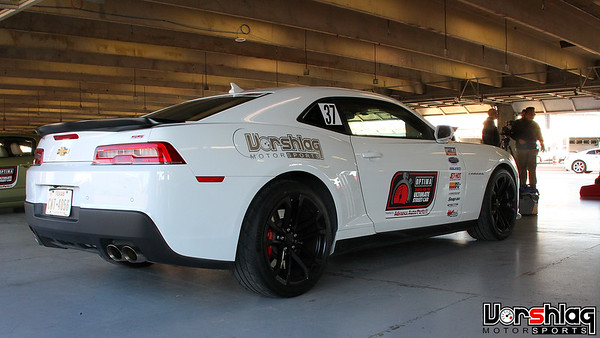 Long time racing buddy Doug Willie autocrossed his 2013 Camaro 1LE in F Street (and Optima!)
5th Gen 1LE's came with 20x10" fronts and 20x11" rear wheels, with 285mm tires at all 4 corners. This was compared to a 19x9" wheel on the 2011-14 Mustang GTs they raced against in F Street. The SCCA allows a +/-1" change in wheel diameter in Street class, keeping the stock widths and within 1/4" of stock offsets. Tire width was unlimited, so many 1LE racers jumped to 19x10" and 19x11" wheels with 305/30/19 or bigger tires. Even with a 200 pound penalty compared to the equivalent year S197 5.0L Mustang, and with similar power levels, the Camaro had a massive wheel width and tire width advantage. This helped these cars overcome their weight disadvantage, and the 1LE Camaros put the screws to the Mustang GTs for a few years in F-Street class.
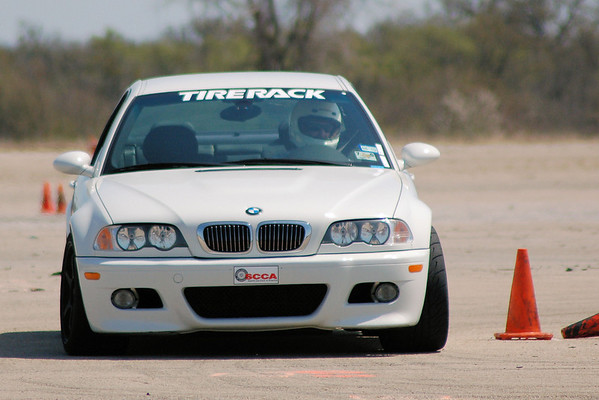 For some reason the SAC moved the E46 and E92 M3s to F-Street
Then the SCCA allowed two generations of BMW M3s into F Street, and those car's better suspensions, lower weights, and some optional factory wheel offerings made them pretty strong there - which has pretty much made the pony cars obsolete in this class - for the time being.

The 6th gen Camaro 1LE might have a better shot in autocross (assuming it is classed in F Street) if GM offers a very wide wheel in stock form (1LE) again, allowing those racers to squeeze more tire under the fenders, to level the playing field (2017 Camaro 1LE comes with 285/30ZR20 front tires and 305/30ZR20 rear tires, so it sounds like 20x10F/20x11R wheels again). These 6th gen 2016+ Camaros are around 200 lbs lighter than the 5th gens (even the Z/28 model), have a strong 455 hp LT1 engine, better rear IRS, but somewhat limited visibility.
EASY HORSEPOWER FROM THE LS3: FULL LENGTH HEADERS
The
best part of a 5th Gen Camaro SS is the
drivetrain. If you are smart and picked the manual transmission SS you got a big 6.2L aluminum LS3 with
426 hp mated to a strong Tremec 6060 manual 6-speed transmission. The automatic equipped SS had a different V8 producing 400 hp - the L99. They are generally shunned for track and autocross use, as are the hot running supercharged 6.2L LSA supercharged V8s in the ZL1. The Z/28 came with a magical
7.0L LS7 V8, but these cars were fairly expensive and had some problem parts, namely the carbon ceramic brakes, which I will talk about below.

Our main tester "Scottish Joe" has been a customer for a few years and at our old shop we installed full length stainless steel American Racing Headers as the first mod we did. Of course I always tell pony car owners - DON'T DO POWER MODS FIRST! But they never listen.


The 426 hp LS3 would seem to have enough power for track use, and it is quite good in stock form, but like most red blooded American males -
and Scottish blokes - Joe wanted a bit more. Who can blame him? I did the same thing to our 2011 Mustang, and had a hunch the same ARH long tube headers would add a big chunk to low, mid range, and top end power to the LS3, just like on our Coyote V8.


The stock log manifolds are pretty heinous on the LS3, and going to a full length header adds the easiest power you are going to find on a 5th gen. They do take some time to remove but its nothing like a the 6-8 hour Coyote Mustang long tube install.


It only took us 3.75 hours to swap the stock manifolds for these 1-7/8" primary ARH long tubes and cats. Joe wanted to keep the stock Camaro exhaust after the cats, which is a bit restrictive, but I've seen much worse "cat-back" factory exhaust systems. At best there's another +10-15 whp left in a custom dual exhaust upgrade (that's what we saw on the Coyote 5.0L when we went from ARH long tubes + stock exhaust to a custom dual 3" exhaust).


We didn't cheat and run the Camaro without catalysts - that's a massive fine for any shop caught doing that to street cars. We chose the high flow cats from ARH to keep the emissions in check.

Once we got the headers installed we took the car to our local tuners, True Street Motorsports, where they did an initial dyno pull. It made 426 whp with the headers and existing K&N cold air kit. They then tuned it with HP Tuners using a conservative "road course / street tune" for 93 octane and achieved 437 whp and 423 wtq. It makes power everywhere and comes on very smoothly. Full length headers are the best bang-per-buck power modification on a modern V8 if you are going to be running the car on a road course.

Superchargers and other forced induction options can make huge power bumps on modern V8 cars - they work well for dyno queens, drag cars and hard parkers, but boost SUCKS on a road course. These systems always heat soak within "ones of laps", even with giant intercoolers, and there is no getting around that fundamental problem with blown V8s.
Even OEM supercharged V8s, the Mustang GT500, Camaro ZL1, Corvette ZR1 and C7 Corvette Z06,
overheat quickly on track. I've seen C7 Z06 Corvettes overheat and go into limp mode in LESS THAN ONE LAP at tracks like COTA in the Texas summer heat. If your supercharged V8
isn't overheating on a road course, you are either: driving very slowly, you are blind, or your car doesn't have accurate gauges.
continued below