Project Update December 1st, 2016: We've been plugging away on the 69 Camaro track car - a project that still doesn't have a name yet - throughout 2016, at a pace dictated by the owner. My last post was in April that caught us up to December 2015 work, but I've been scrambling to keep up with forum project threads, as we have about a dozen threads for cars we're tracking, updating, and working on. We also just wrapped up our best month of November ever, inside of our best year (to date) in 12 years of business, so its been bonkers around here

The picture above shows the Camaro a bit beyond where this build thread update ended, but only by a few weeks - pic was shot in May 2016. This 2-part forum update covers work completed from January through April 2016. I'm writing these updates pretty fast and furious, but still trying to avoid mistakes like I had made time (see my 'mea culpa', below). There is lot to cover, so let's get started where we left off last time - the front end.
MORE FRONT SPLITTER & VALENCE WORK
This front/splitter section is the "business end" of this Camaro, and a place where a considerable number of hours have been spent getting both the aero and aesthetics "right". Last time I showed some of the fabrication work on the dual plane aluminum front splitter and valance.
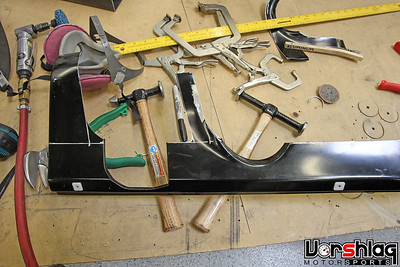

The lower valance panel (above) was based on an OEM piece but stamped in aluminum. It had to be heavily modified to incorporate the lower grill openings and cooler inlets for both the oil and p/s coolers as well as brake cooler inlet ducting. This modified panel and the custom parts below were both tack welded and now needed lots of final welding, sanding, and finish work.

The front splitter assembly was built in stages and the lower valance and cooler inlets are joined together above and below the upper splitter plane. Almost everything here is made in aluminum and bolts together with discretely placed hardware, including the canard sections shown below.
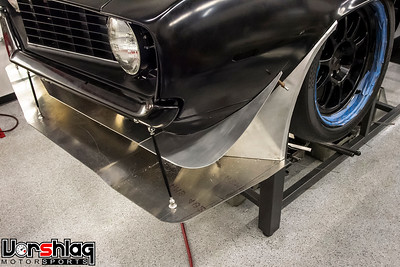

These canards will help direct air spilling off the upper plane where we want, and complete the "lines" of the splitter. Admittedly these parts are part downforce, part styling, but without dozens of hours in a wind tunnel I cannot tell you if these are perfected or not - but this ain't an F1 car. We will do some aero tests in our initial track testing with the customer, of course.

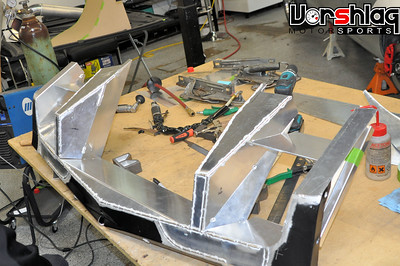
Ryan spent hours and hours final welding the initially tacked aluminum structures of the lower valance and grill openings.
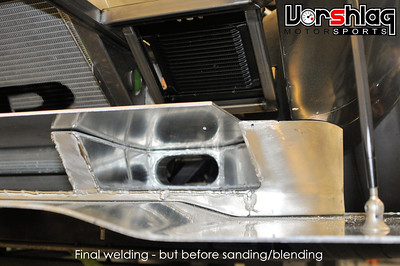
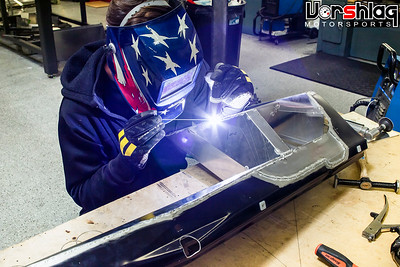
Then he spent hours and hours grinding, sanding, welding, and sanding some more. These components are 100% metal worked, no bondo or putty tricks.


Yes, if there is a major crash it will take work to repair. But so would any custom metal creation built by any other shop. Does it make sense to pull molds off of these finished parts to make "easier to replace" composites? Mold making and composite work is not our specialty, but I have asked others who specialty this is - and they say "expensive". Such is the way of custom car building.
FUEL CELL + MOUNTING
After discussions with the customer about safety, we decided to move from an aftermarket fuel tank to a proper fuel cell. This had a lot to do with the projected track speed and capabilities this car will have, and the customer wanted a SAFE car in the end. A fuel cell also just fits a build of this scale and magnitude.
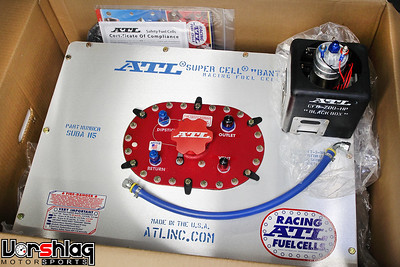

Ryan mapped out the space allocated for the cell and we ordered this custom aluminum ATL cell can and bladder. This was spec'd with the internal surge tank and pumps for ease of plumbing. The surge tank is crucial to keep the fuel pump inlet submerged at all times, even at low fuel levels and 1.5 g or higher loads.
continued below