continued from above
COMPETING IN NASA AND OPTIMA CLASSES
The customer who owns this build is an avid HPDE driver who is used to high powered RWD cars, and now has the Miata track trainer that we built to hone his skills before he jumps into this V8 M3. Before the build began we asked him, like we ask all customers, "What class do you want to build for". This is crucial, as even simple parts choices made early on can limit where you can run any car. We don't ever want to build a car "just for track use" and always encourage folks to at least have some class in mind for "down the road". It tends to make any race car more valuable if it is legal for some class or series.
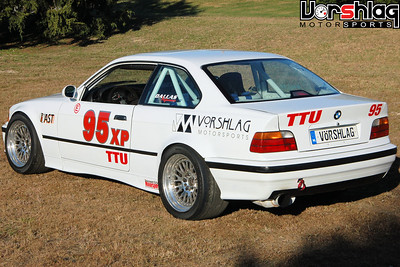

Wheel to wheel racing was never in the cards for this car, so we looked at places where it can compete in Time Trial - which still has a competitive thrill, similar contingencies, but only a fraction of the crash danger of W2W racing. For a car approaching 4 pounds per hp, there is one class you build for in NASA Time Trial: TTU (aka: Unlimited class).
I'm not going to delve into the intricacies of
NASA classing rules for TT, but there are basically a number of classes based strictly on power to weight ratio (TT1/2/3/4), then a few remaining TT Letter classes that are both points based and p-to-w limited (TTC/D/E/F). Basically TTU is fastest, followed by TT1 to TT4, then TTC to TTF are further down the line. TTU will be a tough class to compete in because things like ALMS prototypes and open wheeled race cars are allowed there... but typically TTU acts as a catch-all class for cars that exceed the limits of TT1 or don't have their classing sheets or dyno sheets in order. It is still a rather large class in Texas, most of the time won by Paul Costas' GT1 tube-framed Camaro.

 Left: I'm using the #JankyStick to point out duct tape. Right: Costas setting the weekend's fastest lap at TWS
With numbers around 2700 pounds with driver, "over 500 hp", giant 14" wide slicks with functional aero its going to be pretty hard to beat this car with a unibody BMW coupe chassis with roll up windows, but TTU is just where this car fits. See, I've already got the excuses ready if we lose!

Paul is a good friend of mine and I'm sure he won't mind the "class filler" we will be for him. With 5 in class, a win in TTU pays 2 tires per day if you are running Hoosiers, and with 7 in class pays 1 for 2nd - so even a runner up finish might take home some tires.


For NASA TTU (and HPDE) the car will be run on 335/30/18 front and 345/35/18 rear Hoosier A7 tires, which we had exceptionally good results with in our TT3 car - this car was never beaten in class on these tires, and was easier to drive on than anything else we ever tested. These 345's are the widest DOT tires Hoosier makes, and should work well for this high powered car on the rear. We could possibly use a wider Hoosier 355mm racing slick, but I've found the DOT "A" Hoosier to be a bit friendlier, warm up quicker, and fall off later (more heat cycles) than dedicated racing slicks. I'd wager a very
small amount of money that in the right conditions they are faster than similarly sized slicks. I might lose that bet, but in the first 1-2 laps of a TT session (the only traffic free opportunities) I've rarely seen any tire faster than A7s.

The more serious classing objective for this E46 CSL M3 is Optima's Search For the Ultimate Street Car series, run by the
USCA organization. This is currently the biggest arena to showcase fast cars that have some smidgen of street car capabilities, with a massive variety of cars and a LOT of talented drivers and car builders. I have a lot of friends who compete in this series and missing the last 2 years of events is KILLING me.
We've had a modest amount of success in that series, where Amy and I have entered in Mustangs and Corvettes, and this BMW's owner ran a car at one event also - and enjoyed it a lot. I've always felt like they needed more BMW entrants in Optima, and I have been in contact with the series director to share our plans. Hopefully this hybrid BMW fits within their series parameters and gets as much TV time as our big heavy Mustang did.
Discussing the Optima series rules would take hours, but the basics are this: The USCA runs 8-10 qualifier events each year. There are 4 or 5 classes at these events, and the class winners from each qualifier get invited to Vegas for the "finale event" after SEMA, the Invitational. Here all of the classes get merged into one big shootout with 75-100 cars. Each qualifier and the Invitational are based on 5 competitions: autocross, speed stop, time trial, a road rally to test the streetability of all cars, and a judged car show section called "Design and Engineering". Winning a class at a qualifier is a big deal, as all of these events are televised. Winning the overall at the Invitational is a HUGE deal.


For this series the car has to run a 200 or higher treadwear tire, so we'll build around a 335mm front and 355mm rear street tire - which are the widest available/competitive tires. They won't be as sticky as the Hoosiers but we have some ideas to help manage that. We are building for the GTL class, but that's all I have to share about Optima classing with regards to this E46 M3 CSL clone at the moment. More soon!
WHAT'S NEXT?
In the next installment to this build thread we will show the electric assist steering we added along with the brake upgrades and suspension we have installed. Its all serious stuff that I am pretty happy with.


The max width tire and wheel testing will also be shown, which we used to order the first set of wheels. Then we will cover the unique rear seat mounted fuel cell and dry sump oil tank mounting we tackled for this build.
Thanks for reading,