|
|

07-19-2013, 08:02 PM
|
 |
Senior Member
|
|
Join Date: May 2013
Location: Folsom, CA
Posts: 2,422
Thanks: 45
Thanked 35 Times in 26 Posts
|
|

Quote:
Originally Posted by carbuff

In a similar vein to the TW / WB ratio question, at what point would having a wider front TW compared to the rear TW start to decrease handling performance? Or stated a different way, is there such thing as too much front TW compared to the rear?
|
In case new people drop in on our conversation, track width is center of tread to center of tread. Tread width is outside tread to outside tread (not the sidewall).
I don’t think of track width difference as decreasing handling performance. I think of it as a tuning tool … if the track width is adjustable … or a tuning challenge if it is too far biased on one end and NOT adjustable.
While there are exceptions to almost every rule, I typically don’t want to see the track width difference more than 1” on either end. Even that can be a challenge if it the difference is the wrong direction.
Within reasonable differences making the front track width wider than the rear … or the rear wider than the front can be a practical tuning tool. Making the front track width wider than the rear = tightens the car … too much makes it push. Wider rear track width than front track width = frees the car … too much makes it loose.
Put even more simply, regardless of what is going on at the other end …
a. Moving the front tires out tightens the car.*
b. Moving the front tires in frees the car.*
c. Moving the rear tires in tightens the car.
d. Moving the rear tires out frees the car.
*Note: Adding spacers to the front hubs, increases the scrub radius. So when I can use … either adjustable LCA’s … or simply replace the LCA’s for the track width I want … that is how I prefer to do it, versus adding wheel spacers to the front. I have used wheel spacers in the front many, many times. It’s just not my preferred method. Sometimes class rules dictate the decision.
A LOT of racers use small (1/8” to 1”) wheel spacers to tune … and in fact, many design & build their rear end & front hub combination with spacers as a part of it, so they can be removed to go “in” if needed … and of course, go “out” with more spacer as needed.
For the car I designed for myself with an AutoX priority, the lower control arms use adjustable threaded ends to allow up to 3/4” width change per side … 1.5” total track width adjustment, without affecting the scrub radius. With 335 tires on all 4 corners, my “standard track width” is 55” front & 54.5” rear. I can adjust the front from 54” to 55.5” without spacers.
The rear end in my car will “start” with spacers that can be removed & of course, spacers can be added, for a 2” adjustable track width range in the rear from 53.5” to 55.5” As far as spacers go, I prefer to use them on the rear end only, so as not to affect the scrub radius.
Additional tips: For cars with “high travel/low roll” suspension strategies, the front to rear “track width split” favoring the front works best. For cars with “low travel/high roll” suspension strategies, the front to rear track width split favoring the rear works best.
If your car is already “designed & built” … and the track width is a wider in the front, that will “contribute” to the car being tight/pushy a degree. If the track width is a narrower in the front, that will “contribute” to the car being free/loose to a degree. I use the word contribute, because there are a lot of other suspension & geometry factors affecting the grip at each end of the car. If the track width is not adjustable at either end, you will need to tune with roll center, springs & sway bars to balance the car.
.
__________________
Ron Sutton Race Technology
|
07-19-2013, 08:20 PM
|
 |
Senior Member
|
|
Join Date: Aug 2012
Location: Dawsonville Georgia
Posts: 2,255
Thanks: 652
Thanked 185 Times in 125 Posts
|
|
Great post Ron. Valuable info for free guys!
|
07-19-2013, 08:57 PM
|
|
Senior Member
|
|
Join Date: May 2013
Location: Folsom, CA
Posts: 2,422
Thanks: 45
Thanked 35 Times in 26 Posts
|
|
Quote:
Originally Posted by Che70velle
Great post Ron. Valuable info for free guys!
|
Hey Scott ... thanks. From page 118 to here we've had a pretty good tech discussion going.
Feel free to join in.
__________________
Ron Sutton Race Technology
|
07-19-2013, 09:17 PM
|
 |
Lateral-g Supporting Member
|
|
Join Date: Aug 2007
Location: Southern CA
Posts: 2,723
Thanks: 59
Thanked 63 Times in 21 Posts
|
|
Quote:
Originally Posted by DOOM
Rob I like all the progress you've been making with this beast! Keep it up!
|
Thanks Mario. I hear there are bowties that will be prowling the streets with Twin Turbo Big Blocks in them so I need to be prepared.  
Quote:
Originally Posted by Ron Sutton
If your car is already “designed & built” … and the track width is a wider in the front, that will “contribute” to the car being tight/pushy a degree. If the track width is a narrower in the front, that will “contribute” to the car being free/loose to a degree. I use the word contribute, because there are a lot of other suspension & geometry factors affecting the grip at each end of the car. If the track width is not adjustable at either end, you will need to tune with roll center, springs & sway bars to balance the car.
.
|
 Uh Yea?  How about that? 

|
07-20-2013, 10:52 AM
|
|
Senior Member
|
|
Join Date: May 2013
Location: Folsom, CA
Posts: 2,422
Thanks: 45
Thanked 35 Times in 26 Posts
|
|
Quote:
Originally Posted by FETorino
|
I'm not sure what you said, let alone how to respond. 
.
__________________
Ron Sutton Race Technology
|
07-20-2013, 11:02 AM
|
|
Lateral-g Supporting Member
|
|
Join Date: Aug 2007
Location: Southern CA
Posts: 2,723
Thanks: 59
Thanked 63 Times in 21 Posts
|
|
Quote:
Originally Posted by FETorino
Quote:
Originally Posted by Ron Sutton
If your car is already “designed & built” If the track width is a narrower in the front, that will “contribute” to the car being free/loose to a degree. If the track width is not adjustable at either end, you will need to tune with roll center, springs & sway bars to balance the car.
.
|
Uh Yea? How about that?
|
Quote:
Originally Posted by Ron Sutton
I'm not sure what you said, let alone how to respond.
.
|
Hmm I know of a car as you described above  It sounds familiar.
Oh yea that would be mine
Pretty much non adjustable track width without a  involved.
Track in front a little narrower than the rear. Although I have tightened that up a bit by  and looking at .
there has been a fair amount of discussion on the spring, shock and bar package for my set up.
So it seems that leaves us @
Tune with roll center. Yep that's it 
|
07-20-2013, 12:53 PM
|
|
Senior Member
|
|
Join Date: May 2013
Location: Folsom, CA
Posts: 2,422
Thanks: 45
Thanked 35 Times in 26 Posts
|
|
Rob,
I get it now.
Yes ... your car's wider rear track width ... by 2" ... helps us free up the rear of the big girl a bit. This is a step in the right direction to help overcome the bigger rear tires, but by itself wouldn't be enough.
In the suspension set-up I outlined for you, I bumped the rear spring rate & sway bar rate a "tad" ... but raised the rear panhard bar (roll center) more ... also to help free her up.
Once you hit the track, we'll need to "tune on her" to achieve a good balance & optimum set-up.
.
__________________
Ron Sutton Race Technology
Last edited by Ron Sutton; 07-20-2013 at 02:59 PM.
|
07-20-2013, 03:14 PM
|
|
Senior Member
|
|
Join Date: May 2013
Location: Folsom, CA
Posts: 2,422
Thanks: 45
Thanked 35 Times in 26 Posts
|
|
Alrighty then ... let's talk Roll Centers.
I’ll be very basic for any readers following along that are completely new to this & apologize in advance for boring the veterans with more knowledge of this. Cars have two roll centers … one as part of the front suspension & one as part of the rear suspension. I’ll first explain what role they play in the handling of a car … then how to calculate them … and finally how to tune with them.
Think of the front & rear roll centers as pivot points. When the car experiences body roll during cornering … everything above that pivot point rotates towards the outside of the corner … and everything below the pivot point rotates the opposite direction, towards the inside of the corner. Because the front & rear roll centers are often at different heights, the car rolls on different pivot points front & rear … “typically” higher in the rear & lower in the front.
If you were to draw a line parallel down the middle of the car connecting the two roll centers … this is called the "roll axis" … that line would represent the pivot angle the car rolls on … again “typically” higher in the rear & lower in the front.
.
__________________
Ron Sutton Race Technology
|
07-20-2013, 03:28 PM
|
|
Senior Member
|
|
Join Date: May 2013
Location: Folsom, CA
Posts: 2,422
Thanks: 45
Thanked 35 Times in 26 Posts
|
|
When a car is cornering … the forces that act on the car to make it roll … act upon the car’s Center of Gravity (CG). With typical production cars & “most” race cars, the CG is above the roll center … acting like a lever. The distance between the height of the CG & the height of each Roll Center is called the “Moment Arm.” Think of it a lever. The farther apart the CG & roll center are … the more leverage the CG has over the roll center to make the car roll. Excessive chassis roll angle is your enemy, because it is over working the outside tires & under utilizing the inside tires.
Some people like to look at the car as a unit. I look at it as two halves. Here are some examples … using a typical 3500# Pro Touring Car with 53% front weight… to provide more clarity:
If the CG is 20” high … and the front roll center is 2” below ground … the car has 53% of the 3500# weight with 22” of leverage to roll the front of the car.
If the CG is 20” high … and the rear roll center is 9” above ground … the car has 47% of the 3500# weight with 11” of leverage to roll the front of the car.
* Rolling the car that much more in the front overloads the outside front tire & under utilizes the inside front tire when cornering.
If you lowered the car 2” … the CG drops 2”. The front roll center probably moved too … but it’s not linear … it is based on A-arm angles. Let’s say it dropped 1” in the front to 3” below ground and the rear stayed the same at 9”.
Now …
If the CG is 18” high … and the front roll center is 3” below ground … the car has 53% of the 3500# weight with 21” of leverage to roll the front of the car.
If the CG is 18” high … and the rear roll center is 9” above ground … the car has 47% of the 3500# weight with 9” of leverage to roll the front of the car.
* The front now rolls over less & the rear too, making the car run “flatter” … not flat, just less roll angle … working the inside tires better.
Any weight you can remove from high up … or relocate to lower in the car … moves the CG down … reducing the leverage it has over the roll center … allowing the car to have less roll angle during cornering … working all four tires more evenly … and the grip of four tires is faster than two. 
We’ll discuss moving the roll centers in the final section. Next, let’s cover how to figure out where your front & rear roll centers are at.
---------------------------------------------------------------------------------------------------------------------------------
Front: Measuring all the pivot points in the front suspension to calculate the roll center in the front suspension of a double A-arm suspension car can be tedious … but the concept is quite simple.
Quick Acronyms:
UCA = Upper Control Arm
LCA = Lower Control Arm
BJC = Ball Joint Center
IC = Instant Center
RC = Roll Center
CG = Center of Gravity
CL = Centerline
Your UCA & LCA have pivot points on the chassis … and they pivot on the spindle at the BJC’s. Forget the shape of the control arms … the pivots are all that matter.
.
__________________
Ron Sutton Race Technology
|
07-20-2013, 10:07 PM
|
|
Lateral-g Supporting Member
|
|
Join Date: Aug 2007
Location: Southern CA
Posts: 2,723
Thanks: 59
Thanked 63 Times in 21 Posts
|
|
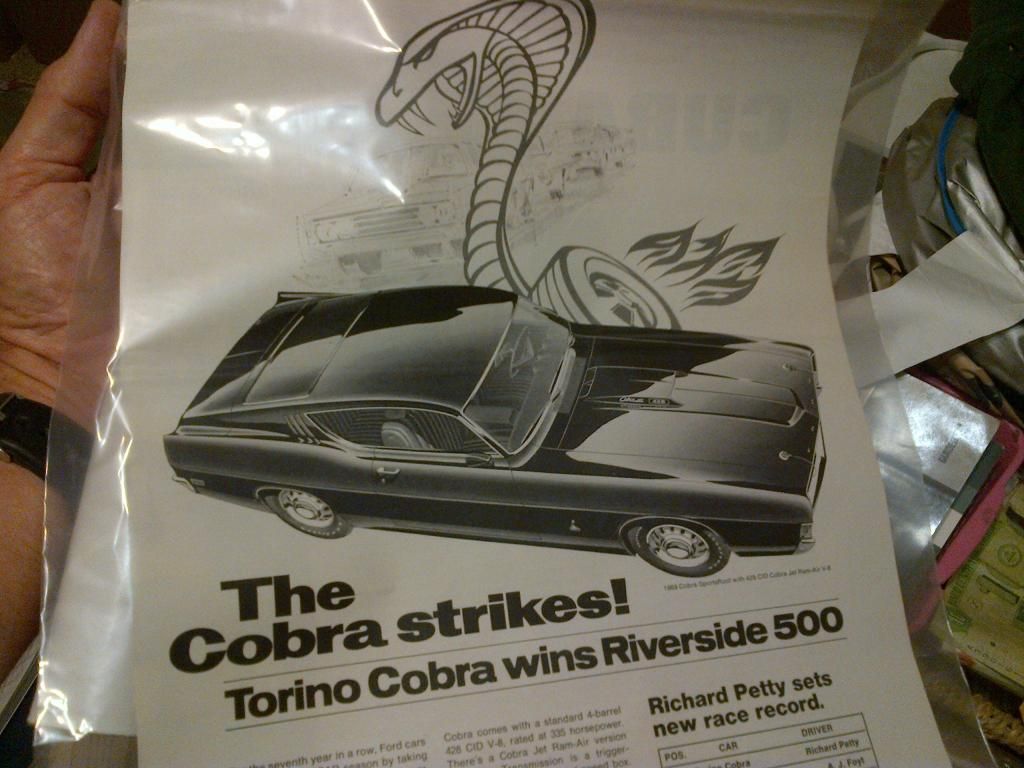
I just catching up on some light reading before I dove into Ron's posts.
|
| Thread Tools |
|
|
| Display Modes |
 Hybrid Mode Hybrid Mode
|
 Posting Rules
|
You may not post new threads
You may not post replies
You may not post attachments
You may not edit your posts
HTML code is Off
|
|
|
All times are GMT -7. The time now is 11:18 PM.
|
















 Brian Hobaugh SCCA National Tour June 2014
 First Hemi 'Cuda Convertible Ever Built
 Short clips: Goodguys Pleasanton autocross and pit videos