To All:
I know this company is not a sponcer on this site, however, I found them to be very helpful on one of my projects, and I thought I would pass along my experiance in an effort to help the fellow enthusiest on this site. I know there are a number of very competent sponcers on this site, many of which I have done business with, and many others I've been in contact with that I am planning to work with in the future.
I sincerely hope, and it is certainly not ment to be offensive, to any of the quality sponcers on this site. Please keep this in mind as you read this.
I had the opportunity to Visit Mast Motorsports this last weekend (They are not very far from where I live) and meet with the guys that design and build these engines. I was very impressed with the facilities and their knowledge in putting the right parts together and getting them tuned to make big power at a real fair price.
Check out their website (Below) and see what kind of engines they offer. I was able to get a very complete LS3 (427 ci.) that makes 600+ hp for $13,000, and this includes just about everything you need to get it running. They Dyno each Engine and give you the Dyno sheet, and they used really high quality parts.
I just bought a Engine for one of my projects and I am fired up. Here are the specs:
====================================
http://www.mastmotorsports.com/gascrate.php
====================================
LS3, 7.0L (Hot Rod/Muscle Car) 600+ HP/ LIST $12995
With M-90 ECM & Wiring Harness
Displacement 427 Cubic Inches
Compression Ratio 11:1
Bore X Stroke: 4.070 X 4.100
LS3 Aluminum Block
Plateau Honed to 4.070True Surface Deck
Engine Block Debured
Blue Printed Shortblock
Rev. Limit 7000 RPM
Crank: Callies 4.100 Stroked Crankshaft
Rods: Callies Compstar Connecting Rods
Pistons: Custom Mahle Motorsports Pistons
Cam: Mast LS7 Core Custom Hydraulic Cam (SS Cam, Duration @ .050 I/E 236/250, Lift I/E .648"/.648", Lobe Separation 114)
LS3 Hydraulic Roller Lifters
Manley 1 Piece Chrome Molly Pushrods
Heads: LS3/L92 Heads
Intake: GMPP L76/L92 Intake
Valve Springs: PAC 1518 Nitrided Beehive
GM Car Harmonic Damper
ACL Rod and Crank Bearings
ARP Head Bolts
ARP Main Studs
Cometic Head Gaskets
M-90 Calibrated ECM
Main Wiring Harness
Dash Harness
Air Mass Harness
Transmission Harness
EGO Harness
Bosch EGO Sensor
Fuel Pump Harness
Fan Harness
LS3 Intake
GM 90mm DBW Throttle Body
Bosch Deadheaded Fuel Rail
Bosch LS3 Fuel Injectors
Mast 8 Layer Air Filter with IAT Bung
Intake Air Temperature Sensor 560-2218 info
Crankshaft Position Sensor
Camshaft Position Sensor
Oil Pressure Sensor
Oil Temperature Sensor
Engine Coolant Temperature Sensor
Engine Knock Sensors
Manifold Air Pressure Sensor
Ignition Coils
Spark Plugs
Plug Wires
GM Foot Pedal
GM Starter
Car Water Pump
LS3 Oil Pan
GM Oil Filter
Extras: $2400 Total
1st Gen Conversion Kit
Motor Mounts for a F-Body Camaro
Fully Programmable Software Package
F-Body Front Runner Package
Hedders (1 7/8 with 3 Inch Collectors)
AN Fuel System with Inline Pump
===================================
These engine packages come with just about everything you need to really get going.
Shaun and Horace were very helpful and knowledgable about their products. This may or may not be the right fit for your project, but for the one I had in mind these guys were very helpful.
If youhave time and are interested, check out their web site and see what you think.
Good luck.
Ty
Once again, this is for general information purposes only. I had a very good experiance and just wanted to let some of the people here know about it. Please don't let anything I said here keep you from investigating and patronizing the sponcers on this site. My experiances with the fine vendors on this site have ALWAYS been positive and I was very please with the fit for the application andthe quality of the items I purchased.
Thanks,
Ty















 Brian Hobaugh SCCA National Tour June 2014
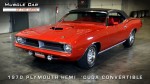 First Hemi 'Cuda Convertible Ever Built
 Short clips: Goodguys Pleasanton autocross and pit videos




 I bought a New Engine for one of my projects! I think this is really a decent deal!


 Threaded Mode