I guess the biggest thing different about it is EVERY time I step on the gas, exiting a left turn, exiting a right turn, in a decreasing radius sweeper, increasing radius sweeper, in the wet...doesn't matter...every time it does exactly the same thing. Once you engage the throttle, the locker locks up and both wheels pull. It has taken a limited traction issue that I used to have to drive around completely out of the picture.
The one oddity of it I guess you could say is a loud clunk it sometimes makes on corner entry when it releases the outside wheel so it can spin faster. It does it to varying degrees...I'm assuming based on how much bind is built up in the locker before it releases. I'm pretty used to it now about 50 autocross runs in the car with it, but the first few times it sure freaked me out. The clunk does NOT upset the car at all and I can tell you this...I've raced the car with the locker several times now on wet courses and contrary to what a lot of people think, the car is very fast in the wet with the locker set up like this.
So...I hope that shows just how happy I am with it.
I will say this though, when we took it apart to swap out the springs...we found some "abnormalities" with how the locker was assembled which were corrected before it was put back together. I now suggest to everyone I talk with that buys a new carrier to take it apart and inspect it before installing it in the car. I'm certain the issue we found would have caused problems down the road but was easy enough to correct once an assembly diagram was located.
__________________
Lance
1985 Monte Carlo SS Street Car
Glad you are happy with the locker. I've heard people say they don't corner well (release / grab at odd times). Ironically none of the people I heard that from had actually owned one.
Years ago I had a friend with one in an ElCamino and it drove fine but I never pushed the car hard. It did make the occasional odd noise but was never unpredictable while I drove the car.
One my second run, halfway through the run I said to my Mom who was along for the ride... "Something is broken"
I was right...
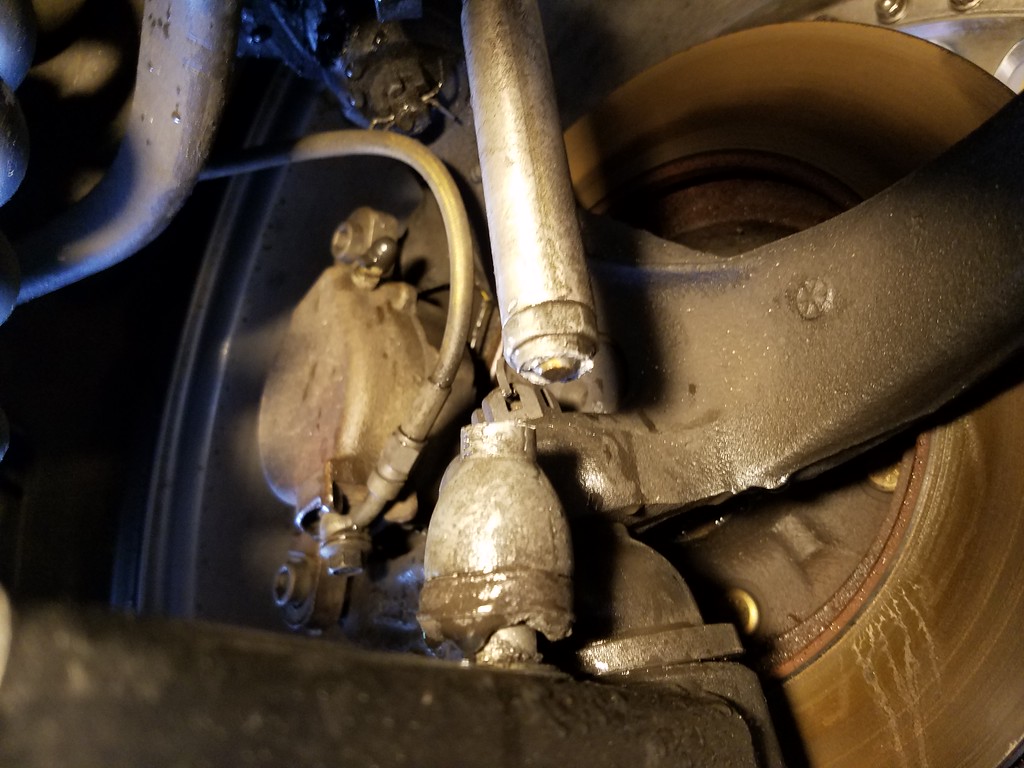
Not sure exactly when it broke, I thought I looked at them pretty closely after the 2nd run and thought they were fine. After the third run is when I noticed the sway bar bushing brackets were loose and I tightened those up but didn't look at the end links again.
We'll get 'er all fixed up and fast again soon though, new parts already on the way.
__________________
Lance
1985 Monte Carlo SS Street Car
....... when you actually take your cars to the track and BEAT ON THEM... oh yeah -- there's consumables... and carnage... and wear... and.... oh my. I actually love that you're experiencing this 'cause, you're out there using it!!
If I would only have crawled under it a bit sooner to investigate...I may not have had to skip yesterday's event... But oh well, I was busy chasing hot air balloons instead.
I did get the car washed Saturday though.
__________________
Lance
1985 Monte Carlo SS Street Car
Lance when I saw the pics of your car leaning so badly to the side, I said to myself that you must have more than a loose sway bar bracket, and that it looked like you had no bar at all in the car. I'm glad you found the issue, and that its an easy fix. Keep digging buddy!
If you pull up the data sheet on the THK ball joints that Ride Tech uses you can see that they are marginally strong enough. I consulted their (THK) engineering department on them and the recommendation is to use a factor of safety of three. That would put the max recommended load around 400#. I am surprised they last as well as they do.
I am surprised at the bolt sizes they use
on today's sway bars. Must be a weight savlngs
thing. My old Herb Adams bars have big heims
on them with bolt ends twice the size of the newer
bars I have recently purchased
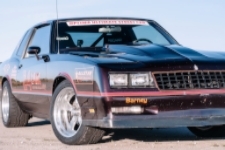
Just a little update for my racing friends on something several of us have been working on this off season. Many of us that are trying to race our older muscle cars have had issues getting our triangulated four link rear suspensions to do something they weren't ever really designed to do...keep both rear tires planted when cornering hard. I have tried many band aids on Barney which all have helped a little, but none really solved the issue completely so I decided it was priority number one this off season. I'm tired of my rear wheel drive car lifting the inside rear tire in the air on corner entry.
My first thought was to put a Watts link on the car to lower the rear roll center. The issue is with the lowered ride height, the very short upper control arms are at an extreme angle and this puts the roll center somewhere up around 18" high or so. A Watts link (or Panhard bar) is sometimes used to lower that roll center to a fixed height but what we found is that the axle housing also migrates left and right while the axle is articulating and if you try to hold the roll center in a fixed position, it puts the rear suspension in a bind.
I first discovered this by doing a little demonstration on my rear axle which you will see in this video. The shocks, springs, and sway bar were disconnected, the axle is held at ride height with a jack and articulated to simulate body roll. You can see the axle migrates over a half inch each direction...no good...and the roll center is somewhere up around the trunk floor and it moves around as the axle articulates. Right after I did that I saw that Scott Wheeler posted pictures of his newly installed rear axle in his bare A body frame and he also had a Watts link frame in place, so I contacted him and asked him to do some additional testing for us with a camera running. I had him disconnect his springs, set his axle at ride height and articulate the housing under several scenarios. What we found was the Watts link bell crank had to be near the very top of the frame in order for the axle to articulate without bind. The idea behind adding a Watts is to not only lower and fix the rear roll center, but to also be able to adjust the roll center quickly to track conditions. This shows us that we just can't get the rear roll center where we want it without creating a bind given the constraints of a triangulated four link. We even took it one step further and disconnected the driver side upper arm to create a"Poor mans 3 link" to show that movement as well. Huge shout out and thanks to Scott for helping with this, the videos really help to show exactly what is going on. Also thanks to Aaron, Ramey Andrew and Ron for contributing to this discussion and helping to find a cure.
Hopefully this visual demonstration will show others that are trying to help their four link suspensions work better what is going on under there...and help them find a solution as well.
We are working on a new plan for Barney which will be revealed soon but we now know this...it will no longer be a four link setup for sure.
__________________
Lance
1985 Monte Carlo SS Street Car
















 Brian Hobaugh SCCA National Tour June 2014
 First Hemi 'Cuda Convertible Ever Built
 Short clips: Goodguys Pleasanton autocross and pit videos





 Linear Mode

