Wow... Not very many people admit that they miss living in Missouri! lol... Thanks for the kind words, the car is a labor of love for me. Mostly labor, little bit of love thrown in.
Engine is bolted to the dyno, I just finished bolting the headers to it. The builder had a few other things to get done so I ran home to grab some lunch and check my emails (work ya know). Will go back up when he calls that he is ready.
__________________
Lance
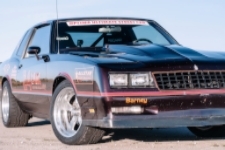
1985 Monte Carlo SS Street Car
I think everyone that knew I would be dynoing my engine asked me "What do you think it will make?" There is always a lot of talk and banter about the "number" one gets after dyno session. I've maintained all along that I wasn't really worried about the "number", I just wanted a lot more top end power than I had before and the engine to be just as reliable and street friendly as it was in it's former form.
My builder got a late start today and had a few other things going, so we didn't get going with the pulls until after 4 pm today. We talked about holding off until tomorrow and starting over but the weather is going to turn bad and there is a small football game I'm fairly invested in starting at 3 pm tomorrow, so I talked him into just making a few pulls with it tonight, then loading it up and taking it home. It is now sitting on my shop floor...
The engine fired right up, no issues, Yancy adjusted the idle air screws just a bit and broke the engine in before I got there. Once we decided to make the pulls tonight, it fired right back up again and he put the hammer to it once warm.
After looking at the sheet, I was pleased...really pleased. We talked about a few things, discussed some options, the put my air cleaner spacer and air cleaner on it and made another pull.
It really REALLY liked the air cleaner. Yancy said it is most likely due to the spacer and filter smoothing out the airflow before it got to the air horn. It was a bit fat on the top end on the first pull and that evened right out on the second pull with the air cleaner in place. I should also add that this was done with my 1 5/8s mid length headers installed and about 3' of my exhaust head pipe attached to them.
I could post the peak "number" it hit, but that really wouldn't tell the story. What really pleases me about the engine is the torque curve down low AND the peak HP number up top. I'm also very happy that the engine idles smooth as silk at 825 RPM and the air fuel ratios look good across the board. The engine is ready to drop back in Barney and rock, nothing else needed.
Maybe I should do a poll... Everyone here knows what we put into the engine, what do you think it did?
My only disappointment is in our hurry to make the pulls, Yancy forgot to clear the screen that shows the torque and HP curves...so that screen showed the last 50 dyno sessions he's done along with mine, so it was unreadable.
__________________
Lance
1985 Monte Carlo SS Street Car
Because the heads were bought used, we really didn't know how they were going to flow. Apparently the work that Brzezinski did on them for the previous owner made the heads much more efficient than we planned on. My friend that helped with the cam selection was disappointed that we undershot the peak RPM, the engine made peak HP at 5400 RPM and peak TQ at 4100 RPM. I'm alright with this though as this helped the torque curve down lower which I was more concerned about than the peak hp number. It still pulls on through 6000 RPM only dropping about 20 hp from peak.
To me, this is why we put it on the dyno. Not to see what the peak number was but to see the curves and where the peaks were (and mostly just to break it in and make sure there were no issues). Every dyno is different and especially when corrected for conditions...who knows what the real number is. On a different dyno on a different day, I'm sure the numbers could be 30 or 40 off of this in either direction. For this dyno...and the conditions present at the time, this is what it made.
524 ft lb at 4100 RPM and 467 HP at 5400 RPM.
That was the last pull with the air cleaner and spacer on. It was about 5 hp higher throughout than the 2nd pull (first with air cleaner on).
Here is the first pull without the air cleaner on.
As you can see it made 50 ft lbs and 22 HP more at peak with the air cleaner and spacer installed!!
I am VERY happy with the results...ecstatic even. I can't wait to see what the butt dyno feels like. I'm slightly concerned that I may now have a more serious traction issue.
__________________
Lance
1985 Monte Carlo SS Street Car
Not if I can help it. I pretty much hate headers on a street car anyway and these are about as street car friendly of a header that I have ever seen. I told the builder before the dyno session that I'd give up 20 hp just to not have to deal with long tube headers... He looked at me like I was crazy...
He said most everyone that comes in his shop is looking for every little bit of power they can get regardless... I guess I'm just different. That shouldn't be news to anyone here though.
__________________
Lance
1985 Monte Carlo SS Street Car
That will work, nice numbers. Do you have the air to fuel ratios for the pulls with and without the air cleaner? The air cleaner must have dialed in the jetting.
He couldn't find his O2 sensor as he almost never uses it. As he explained to me the dyno calculates the ratio based on the fuel that goes in and the air that comes out of the engine. That is the far right column on the two sheets.
He said that 0.500 is right at 12:1, when the number gets down into the 0.4xxs it is leaning out a bit and making more power...up into the high 0.5xxs to the 0.6xxs is getting richer.
On the pull without the air cleaner, at 5400 (peak HP) it was 0.590 and the pull with the air cleaner it was 0.539.
The fuel lb/hr column shows it using 189.9 without the AC and 181.4 with the AC, so it was using less fuel to make more power by running leaner with the air cleaner and spacer. In other words the AC and spacer let more air get into the engine faster and smoother.
At 4100 (peak torque) it was 0.497 without the AC and 0.475 with the AC, fuel consumption was 134.9 and 143.0 respectively.
So it was using more fuel and running leaner at 4100 RPM with the AC and making 48 more ft lbs of torque.
BTW, this was all done with the distributor locked down at 32 degrees timing, no advance, no curve, no nothing...just 32 degrees timing and burning 91 octane pump gas.
I have an A\F meter in the car and will verify that it's still safe once all back together and on the road, but I'm certain that it will be fine even if I stumble on a bad tank of gas somewhere along the line.
__________________
Lance
1985 Monte Carlo SS Street Car
Lance, are you running an ignition box to alter timing? Nice numbers!
You might need bigger rear tires...
Great job getting us detailed information, as usual!
















 Brian Hobaugh SCCA National Tour June 2014
 First Hemi 'Cuda Convertible Ever Built
 Short clips: Goodguys Pleasanton autocross and pit videos




 Everyone here knows what we put into the engine, what do you think it did?



 Linear Mode

