...

Go Back   Lateral-g Forums > Technical Discussions > Chassis and Suspension
User Name
Password


Reply
 
Thread Tools Display Modes
  #1  
Old 09-23-2007, 08:06 AM
Derek69SS's Avatar
Derek69SS Derek69SS is offline
Supporting Member
 
Join Date: May 2005
Location: Dexter, MN
Posts: 963
Thanks: 0
Thanked 0 Times in 0 Posts
Default

In all honesty, you can get equal geometry improvements with bolt-on parts on your stock chassis for a LOT less money. The only real benefit I see over the right combination of bolt-ons is the added chassis rigidity.

The big rear tires are cool if you're not serious about road-racing/track days (which most of us aren't but if you are...), they will come up to temp much slower than the smaller fronts, effecting the balance of the car differently throughout the run... if it starts neutral, when the fronts get sticky it will go loose, then the fronts get too hot as the rears just start to get sticky and it goes tight. They also require running the springs/shocks further inboard negatively effecting the motion-ratios.

Edit: ...should add the big tires may help on a tight course such as an autocross, but likely a hinderance on a big course.

Last edited by Derek69SS; 09-23-2007 at 08:22 AM.
Reply With Quote
  #2  
Old 09-23-2007, 12:38 PM
XcYZ's Avatar
XcYZ XcYZ is offline
Administrator
 
Join Date: Jun 2004
Location: Rochester, Minnesota
Posts: 8,998
Thanks: 0
Thanked 0 Times in 0 Posts
Default

Quote:
Originally Posted by Derek69SS
The big rear tires are cool if you're not serious about road-racing/track days (which most of us aren't but if you are...), they will come up to temp much slower than the smaller fronts, effecting the balance of the car differently throughout the run... if it starts neutral, when the fronts get sticky it will go loose, then the fronts get too hot as the rears just
start to get sticky and it goes tight.
I will agree with that, but if you're going to look at how the tire temp changes are different with different size tires, then you might as well start looking at everything, such as fuel load. As you use fuel your balance is going to change, just like it will with tire temps. I know some guys that used to race using methanol but have switched to race gas because you don't use nearly as much over the course of the race, which means the change in balance isn't as drastic.

Of course, with street tires, this is just about pointless. lol But if you're serious about competing (in sanctioned racing), nothing is left out of the equation.

I still say that tire sizes differences from front to rear can be dialed in with the right chassis setup.
__________________
Scott

My LS7 69 Camaro
Reply With Quote
  #3  
Old 09-23-2007, 01:09 PM
68protouring454's Avatar
68protouring454 68protouring454 is offline
Senior Member
 
Join Date: Jul 2004
Posts: 1,593
Thanks: 0
Thanked 1 Time in 1 Post
Default

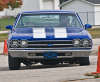
they were out of the top 5 until they got to hot lap it 4-5 extra laps to knock the last 2-3 10ths off, at the end before the top 5, the car is cool and did well for a boat..
cool chassis, and they were nice guys too.
__________________
Jake's Rod Shop

Last edited by 68protouring454; 09-23-2007 at 02:05 PM.
Reply With Quote
  #4  
Old 09-29-2007, 08:42 AM
PTAddict PTAddict is offline
Senior Member
 
Join Date: May 2005
Posts: 292
Thanks: 12
Thanked 25 Times in 14 Posts
Default

Quote:
Originally Posted by Derek69SS

The big rear tires are cool if you're not serious about road-racing/track days (which most of us aren't but if you are...), they will come up to temp much slower than the smaller fronts, effecting the balance of the car differently throughout the run... if it starts neutral, when the fronts get sticky it will go loose, then the fronts get too hot as the rears just start to get sticky and it goes tight. They also require running the springs/shocks further inboard negatively effecting the motion-ratios.
FWIW, my '71 Camaro with a modified LS1 uses 265 front and 295 rear Pilot Sport Cup tires on the track (Portland Raceway). After a 20 min session, the pyrometer shows the rear tires 5-10 degrees hotter than the fronts, even with 4 PSI greater hot pressure.

I notice that high-powered RWD cars with near 50/50 weight balance (Viper, Z06) are often running 50mm or more rear stagger, even in full-race setups. You want that kind of car to keep the rear end stuck down when hard on the throttle exiting turns. Something like, say, a spec Miata is a somewhat different story ...

Finally, keep in mind that a solid axle car provides no provision for negative camber in the rear. Personally, I will run the biggest tires that will fit on both ends, then tune with camber, shocks, and tire pressures.

Reply With Quote
Reply

Thread Tools
Display Modes

Posting Rules
You may not post new threads
You may not post replies
You may not post attachments
You may not edit your posts

BB code is On
Smilies are On
[IMG] code is On
HTML code is Off

Forum Jump


All times are GMT -7. The time now is 05:50 PM.


Powered by vBulletin® Version 3.8.11
Copyright ©2000 - 2026, vBulletin Solutions Inc.
Copyright Lateral-g.net